
AI Email Writer for Sales Emails: Write Sales Emails That Convert
A sales email only works if it gets opened, read, and answered, and a professional AI email writer helps clear all three bars by drafting a tight, personalized, on-message message in seconds. Yes, AI can write sales emails — it produces the subject line, opener, value-driven body, and call-to-action, while a rep still supplies the prospect research and the final edit.
This guide covers whether AI-written sales emails actually work, the anatomy of a message that converts, a step-by-step workflow for using an AI sales email generator, and what the available data says about subject lines, CTAs, length, personalization, timing, and follow-up.

Can an AI Email Writer Write Sales Emails?
An AI email writer turns a short prompt and a handful of prospect details into a structured sales email — subject line, opener, body, and CTA — in a matter of seconds. That speed matters because of the environment the email lands in: the average professional inbox receives somewhere in the neighborhood of 120-150 emails a day, so a message that is loosely organized or generic gets skimmed and archived before it earns a reply. A model trained on proven email structure can consistently hit the right shape — short opener, one benefit, one ask — far faster than a rep drafting from a blank page.
Yes, with a human still in the loop
The AI produces the first draft; it does not replace the rep. Treat the output as a strong starting point that still needs a human voice pass before it goes out. A practical split looks like this:
- AI drafts: subject-line options, the opener, the body copy, and the CTA phrasing.
- Rep supplies: who to target, the specific trigger or pain point, and any account context the AI wasn’t given.
- Rep owns: the final read-through for tone, accuracy, and whether the message actually sounds like a person.
Why it matters for the sales funnel
Email remains one of the highest-return channels available to a sales team — third-party research on email marketing commonly cites figures in the range of $36 to $44 returned for every $1 spent, though the exact multiple varies by study and industry. A professional AI email writer lets one rep produce more well-structured, on-message drafts in the same amount of time, which means more prospects receive a relevant message instead of a rushed, templated one.
Anatomy of a Sales Email That Converts
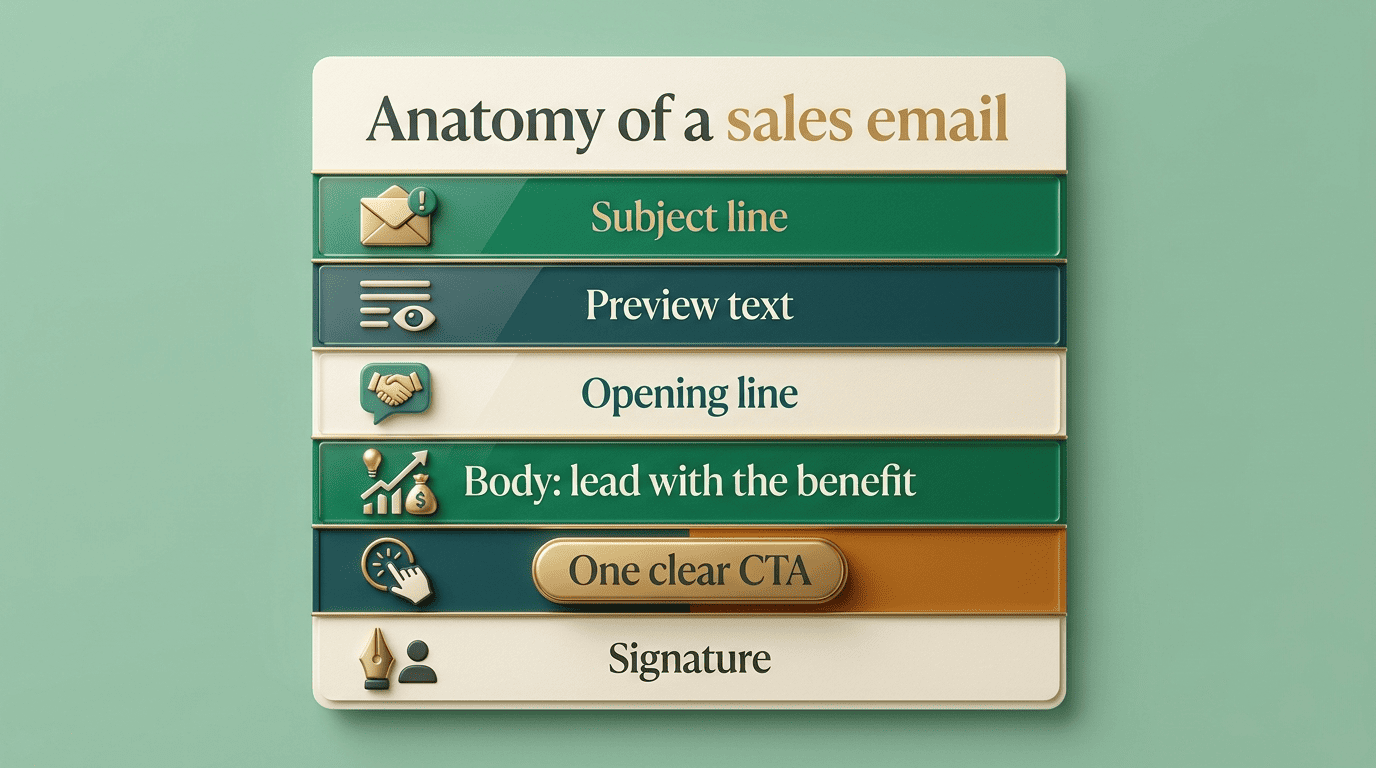
A converting sales email is built from a small, repeatable set of parts, and every high-performing message in a sequence tends to include all of them rather than skipping one to save time. Cutting a part — dropping the CTA, skipping preview text, reusing a generic opener — is the most common reason a technically well-written email still gets no reply.
| Part | Job | Common mistake |
|---|---|---|
| Subject line | Earns the open | Vague, generic, or clickbait |
| Preview text | Reinforces the subject | Left blank or duplicated from the first line |
| Opening line | Proves it’s not a mass blast | Starts with «I hope this finds you well» |
| Body copy | Connects offer to prospect’s goal | Leads with features, not benefits |
| Call-to-action | Earns the reply | Asks for too much, or asks for two things |
| Signature | Builds trust | Missing name, role, or contact path |
Many of the best-performing sales emails informally follow the AIDA model — Attention, Interest, Desire, Action — a copywriting framework that predates email by decades and maps cleanly onto those six parts: the subject and opener earn Attention and Interest, the body builds Desire around the prospect’s goal, and the CTA drives Action. The body should connect the offer to something the prospect already cares about and lead with the benefit rather than a list of product features. Keep paragraphs short and scannable — a dense wall of text gets skimmed on a phone screen, not read.
How to Write a Sales Email With AI, Step by Step
Using an AI sales email generator well is less about the prompt and more about the inputs a rep feeds it before generating anything. The workflow below turns a blank draft into a sendable email in a few minutes.
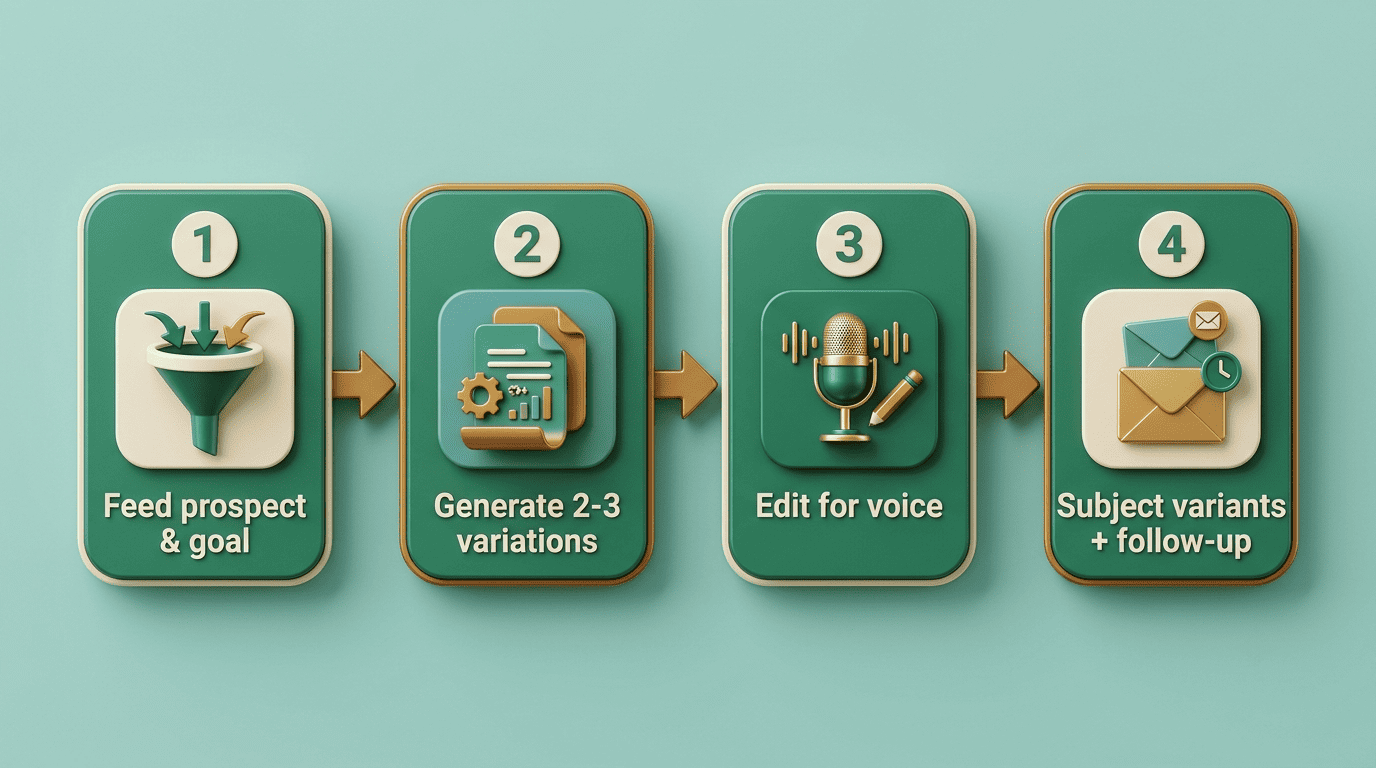
- Feed the AI the prospect and the single goal. Tell the AI email writer who the recipient is, what they likely care about, and the one outcome the email should drive — a reply, a call, a demo. Give it these inputs at minimum: prospect name and role, company and recent trigger event, the specific pain point being addressed, and the single desired next step.
- Generate two or three variations. Ask for multiple angles on the same email rather than accepting the first draft, then pick the one that best matches the prospect’s situation.
- Edit for voice and cut fluff. Read the draft out loud, remove anything that sounds templated, lead with the benefit, and trim it down — a shorter, sharper email almost always beats a longer, hedged one.
- Generate 3-5 subject-line variants. Have the tool produce several short options so the rep or the team can A/B test rather than guessing at one subject line.
- Attach a short follow-up sequence. Ask for two to three follow-up drafts at the same time as the original, spaced a few days apart, so the sequence is ready before the first email even sends.
- Check sending hygiene before hitting send. Personalization is the single biggest lever available — a practical version of the «5×5 rule» (roughly five minutes researching the prospect, five minutes drafting or editing) keeps quality high without turning outreach into a full research project. Good sending hygiene still matters at scale: Google’s guidelines for bulk senders expect low spam-complaint rates, valid authentication, and an easy unsubscribe path, all of which affect whether the email reaches the inbox at all.
- Send, track, and feed results back. Note which subject line and CTA got replies and reuse that pattern in the next batch — the AI improves the next draft when it knows what actually worked.
Subject Lines That Get Opened
Roughly 47% of recipients decide whether to open an email based on the subject line alone, before they see anything else, which makes it the single highest-leverage line in the entire message. A subject line does not need to be clever — it needs to be specific enough to signal relevance in a fraction of a second.
- Keep it under about 60 characters; the first 30-40 characters are what actually shows on a mobile inbox.
- Reference something concrete — a company name, a role, a shared trigger event — rather than a generic hook.
- Personalize it whenever the AI has enough prospect data to do so credibly.
- Avoid spam-trigger phrasing («free,» excessive punctuation, all caps) that can hurt deliverability as much as open rate.
What a realistic target looks like
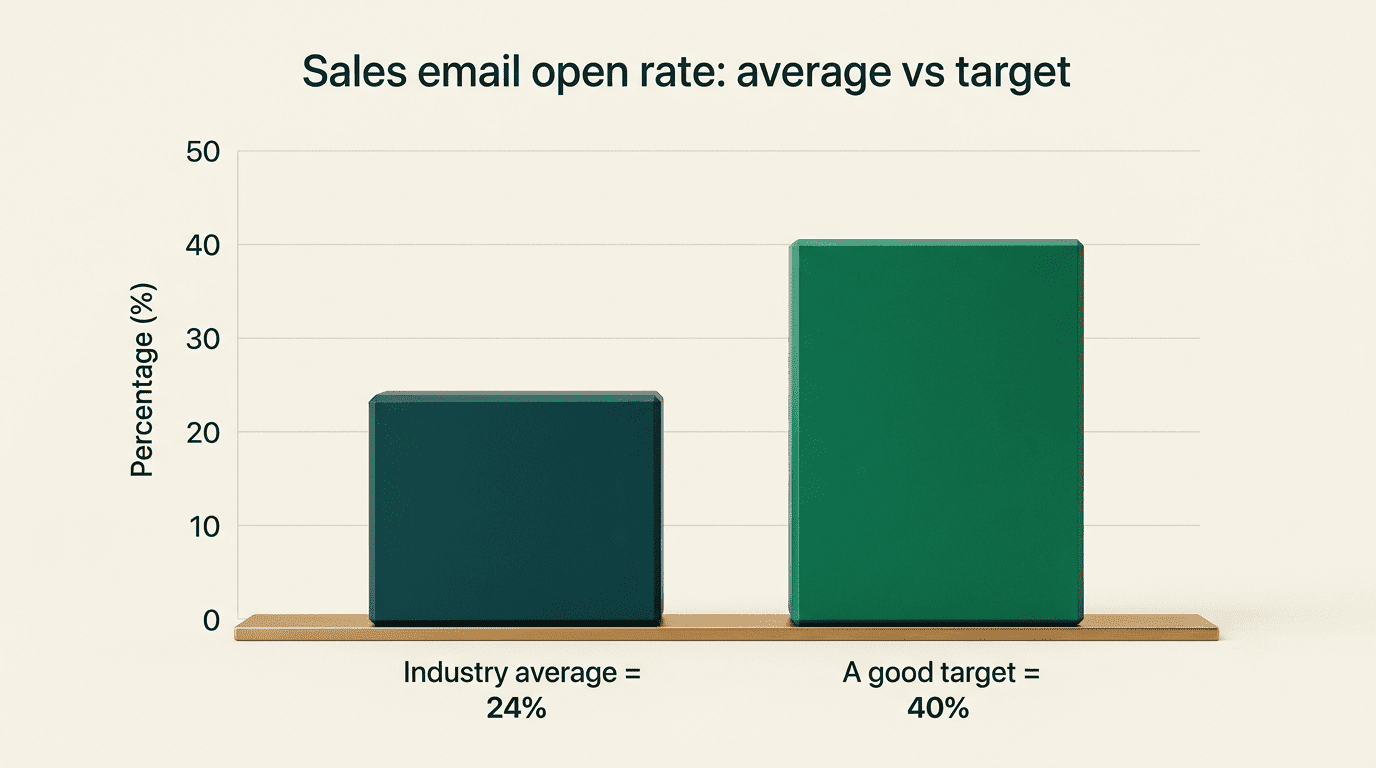
Average sales email open rates sit around 23.9% across studies, so a well-written subject line built around the rules above should realistically be aiming for something closer to the 30-50% range rather than treating industry-average as a ceiling. The only reliable way to know which subject line works for a specific list is to test it directly against another version and let real replies decide.
A/B test instead of guessing
Split a list and send the same body with two different subject lines, then keep the version that produced more opens and replies for the next batch. Because an AI email writer can generate several credible subject-line variants in seconds, there is little reason to send an entire campaign on a single untested guess.
CTAs and Length: What the Data Says
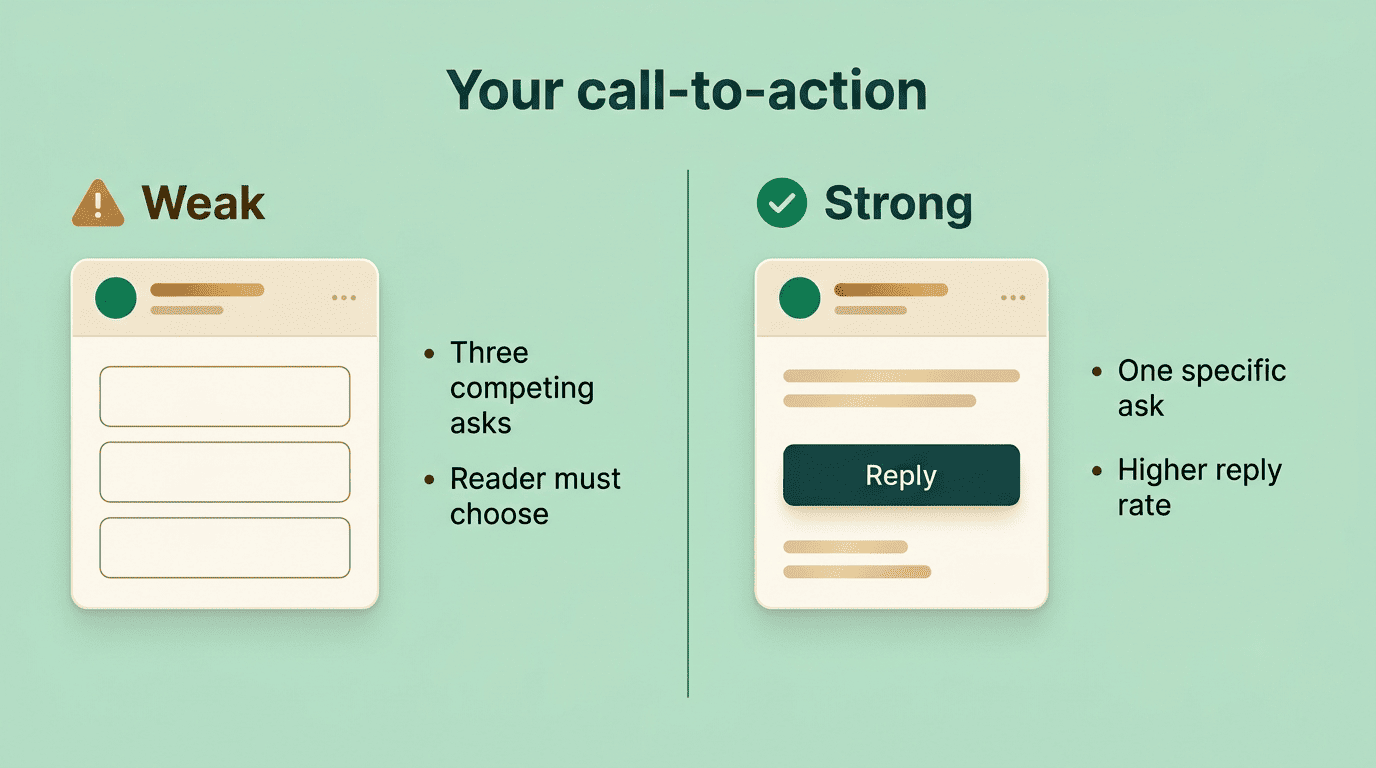
The call-to-action is where most sales emails lose the reply they otherwise earned, usually because the ask is vague, oversized, or split across two competing requests in the same message.
One specific CTA wins
Gong’s analysis of 304,174 sales emails found that a specific call-to-action (naming a day and time) gets far more effective as a deal advances — it books meetings at roughly 15% in the cold-outreach stage but climbs to 37% once a prospect is already in an active deal. Early on, though, a softer ask wins: in that same cold-outreach stage, asking for interest — something closer to «Is this worth a conversation?» — outperformed asking directly for a specific time by more than 2x. The lesson generalizes: match the ask to the stage — a narrow, low-commitment ask converts better early on, while a specific, concrete ask converts better once the prospect is already engaged.
| Data point | Finding | Source |
|---|---|---|
| Specific CTA, cold stage vs. deal stage | 15% to 37% meetings booked | Gong |
| «Interest» ask vs. «time» ask (cold stage) | 2x+ better response (304,174 emails) | Gong |
| Cold email length (4+ sentences, ~30-150 words) | Meaningfully higher meeting-booking odds | Gong |
| Generic «ROI» language | ~15% lower cold-email success | Gong |
| Subject-line-only open decisions | 47% of recipients | Industry studies |
| Average sales email open rate | ~23.9% | Industry studies |
Timing, Follow-Up, and Compliance
When an email sends can matter almost as much as what it says, and most reps under-send follow-ups by a wide margin relative to what the data supports.
When to send and how to follow up
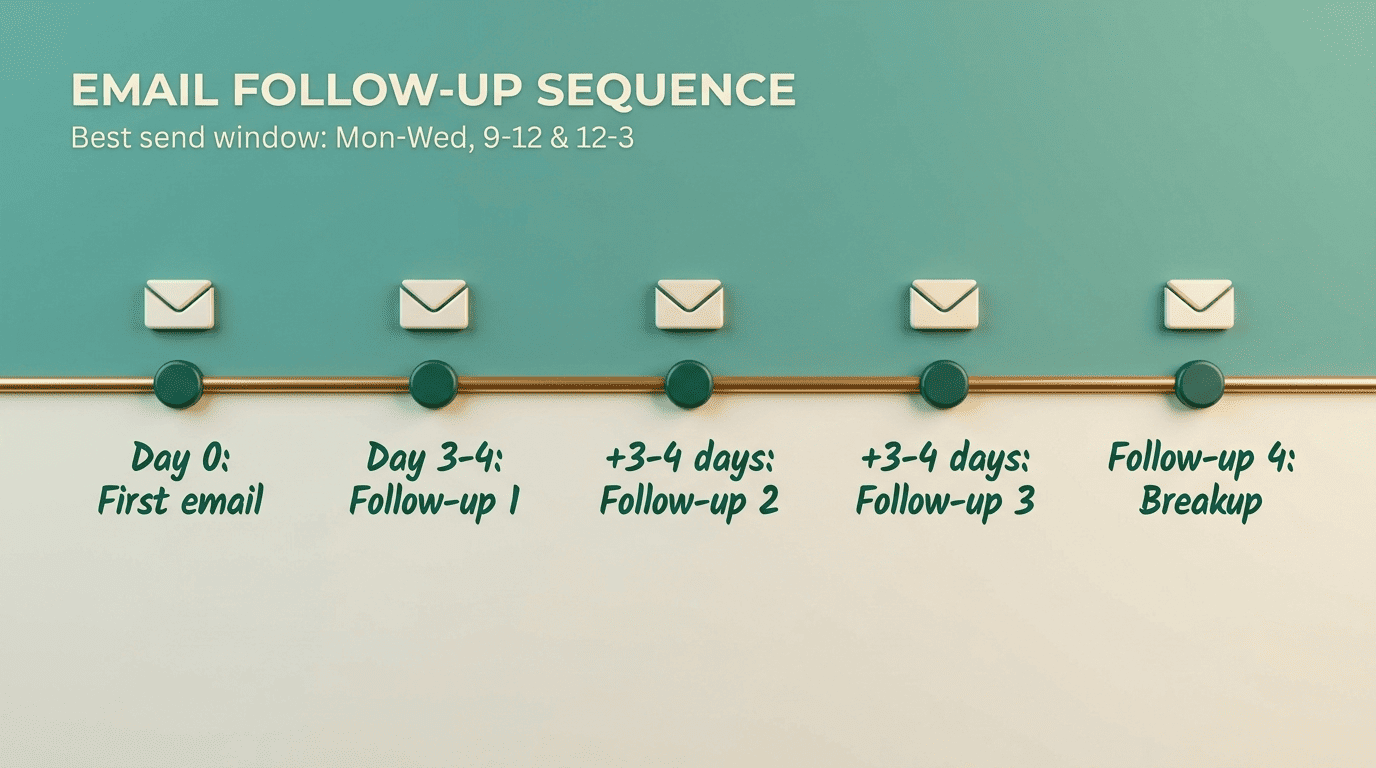
Engagement on sales emails tends to be highest between 9 AM-12 PM and again from 12 PM-3 PM, Monday through Wednesday, though any individual list should still be tested rather than assumed. Follow-ups are responsible for roughly half of outbound sales success overall, yet most reps stop after one or two attempts. Plan on at least four touches, spaced three to four days apart, and close the sequence with a graceful breakup email rather than letting it trail off.
Compliance is the sender’s job, not the AI’s
A professional AI email writer can draft compliant-sounding copy, but it cannot verify a mailing list or attach a physical mailing address — that responsibility sits with the person sending the email. In the US, commercial sales emails must follow the CAN-SPAM Act. As the Federal Trade Commission puts it in its compliance guidance:
The CAN-SPAM Act doesn’t apply just to bulk email. It covers all commercial messages, which the law defines as «any electronic mail message the primary purpose of which is the commercial advertisement or promotion of a commercial product or service.»
Federal Trade Commission, CAN-SPAM Act: A Compliance Guide for Business
That means a single cold sales email, not just a mass campaign, has to meet the same basic requirements:
- An accurate, non-deceptive subject line and header information.
- Clear identification that the message is an advertisement, where applicable.
- A valid physical postal address for the sender.
- A clear, working way for the recipient to opt out of future emails.
- Opt-out requests honored within the legally required window, without exception.
Mistakes to Avoid With an AI Sales Email
A few habits quietly undo everything above, even when the draft itself was strong to start with.
- Don’t mass-send unedited AI copy. A first draft from an AI email writer is a starting point, not a finished message — sending it verbatim to a whole list is the single fastest way to sound like a bot and get marked as spam.
- Don’t stack multiple CTAs. Asking for a call, a demo, and a reply in the same email splits attention and lowers the odds that the prospect acts on any of them; the data above is clear that one specific ask consistently outperforms several.
- Don’t lead with features or ROI buzzwords. Opening with a feature list or generic «ROI» language reads as templated and, per Gong’s data, measurably lowers cold-email success — lead with the prospect’s situation instead.
- Don’t skip personalization to save time. A generic body sent to hundreds of contacts converts far below a message that references something specific to the prospect, even when that personalization takes only a few extra minutes per email.
- Don’t ignore the follow-up sequence. Sending one email and moving on discards roughly half of the outbound success available in the process — plan the follow-ups before the first email goes out, not after it gets ignored.
FAQ
Related guides: writing cold outreach emails and subject lines that get opened.