
AI Email Writer for Cold Outreach Emails: Write Cold Emails That Get Replies
Cold outreach lives or dies on the first sentence, and this is exactly where an AI email writer earns its keep — it drafts a personalized, on-brand cold email in seconds so you can spend your time on the prospect, not the blank page. Yes, AI can write effective cold emails: it generates the opener, the pitch, the subject line, and the follow-ups, but the human still owns the targeting and the final edit, a distinction outlined in Wikipedia’s overview of cold email as a form of direct, unsolicited outreach.
This guide covers whether AI cold emails actually work, the anatomy of a strong cold email, a step-by-step workflow with an AI email writing tool, plus deliverability and CAN-SPAM basics so your outreach lands in the inbox, not the spam folder.

Can an AI Email Writer Actually Write Cold Emails?
Yes — with a human in the loop
An AI cold email generator drafts the message from your inputs — the offer plus prospect data — but it does not decide who to email. Testers of AI email writing assistants report that AI drafts are rarely ready to send without human editing, which is the right way to think about the tool: a fast first draft, not the final word. In practice, the split looks like this:
- The AI email writer generates: the subject line, the personalized opener, the value-proposition sentence, and the follow-up sequence
- The human still owns: the target list (ICP), factual accuracy, final tone check, and the send decision
The AI email assistant compresses the blank-page problem into seconds; the judgment about tone, accuracy, and fit still belongs to the sender.
The evidence it works
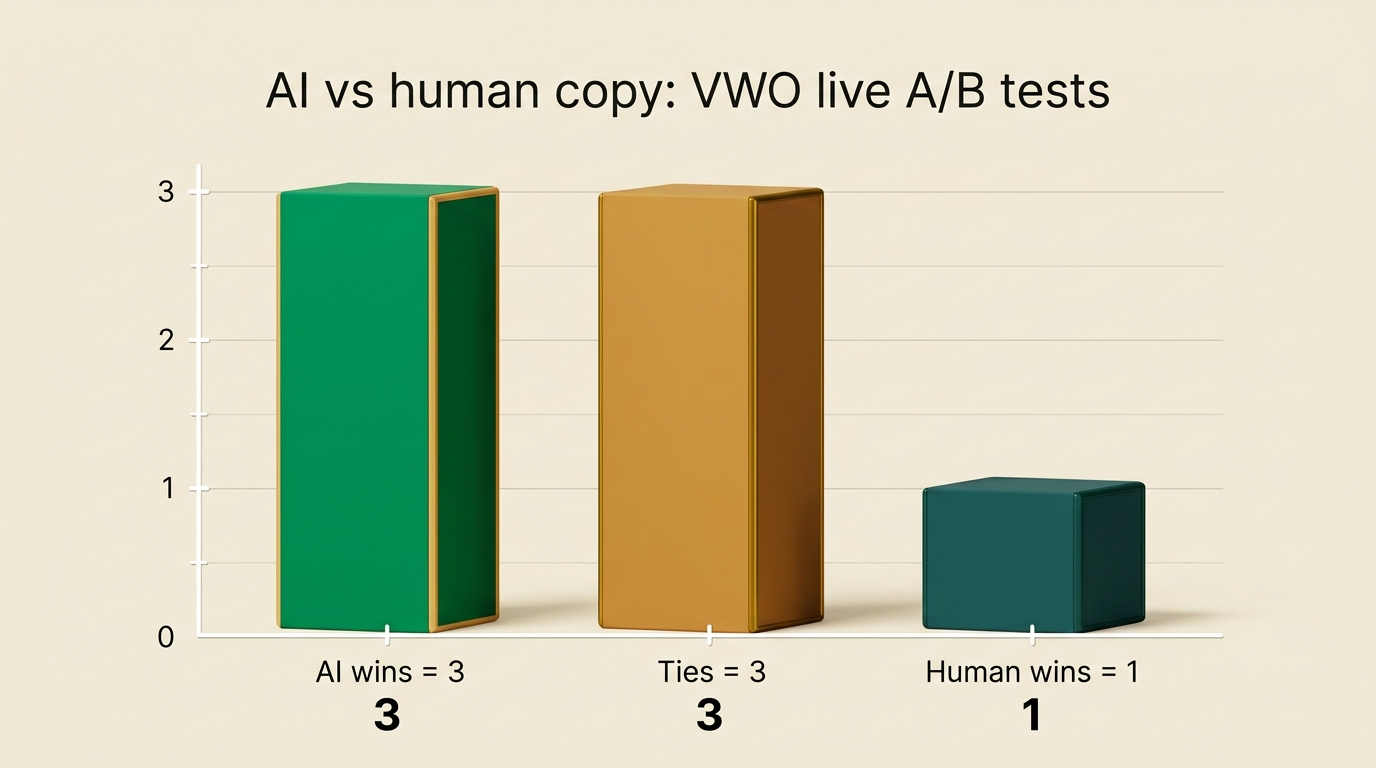
Cold email remains a genuinely competitive channel for B2B sales teams, and it hasn’t been displaced by other outreach formats even as AI writing tools have become common. In a running competition hosted by the conversion-optimization platform VWO, in which participating companies pitted AI-generated copy against their existing human-written copy across live A/B tests, the confirmed results were 1 human win, 3 AI wins, and 3 ties, with several more tests inconclusive. The tests covered landing-page headlines, banner copy, and call-to-action text rather than email specifically, but the takeaway generalizes: AI-generated copy performs at least on par with human-written copy, and in several head-to-head pairs, slightly better.
Anatomy of a Strong Cold Email
A cold email that converts is built from a small, fixed set of parts, and an AI email writer is most useful when it fills each one deliberately rather than producing one undifferentiated block of text.
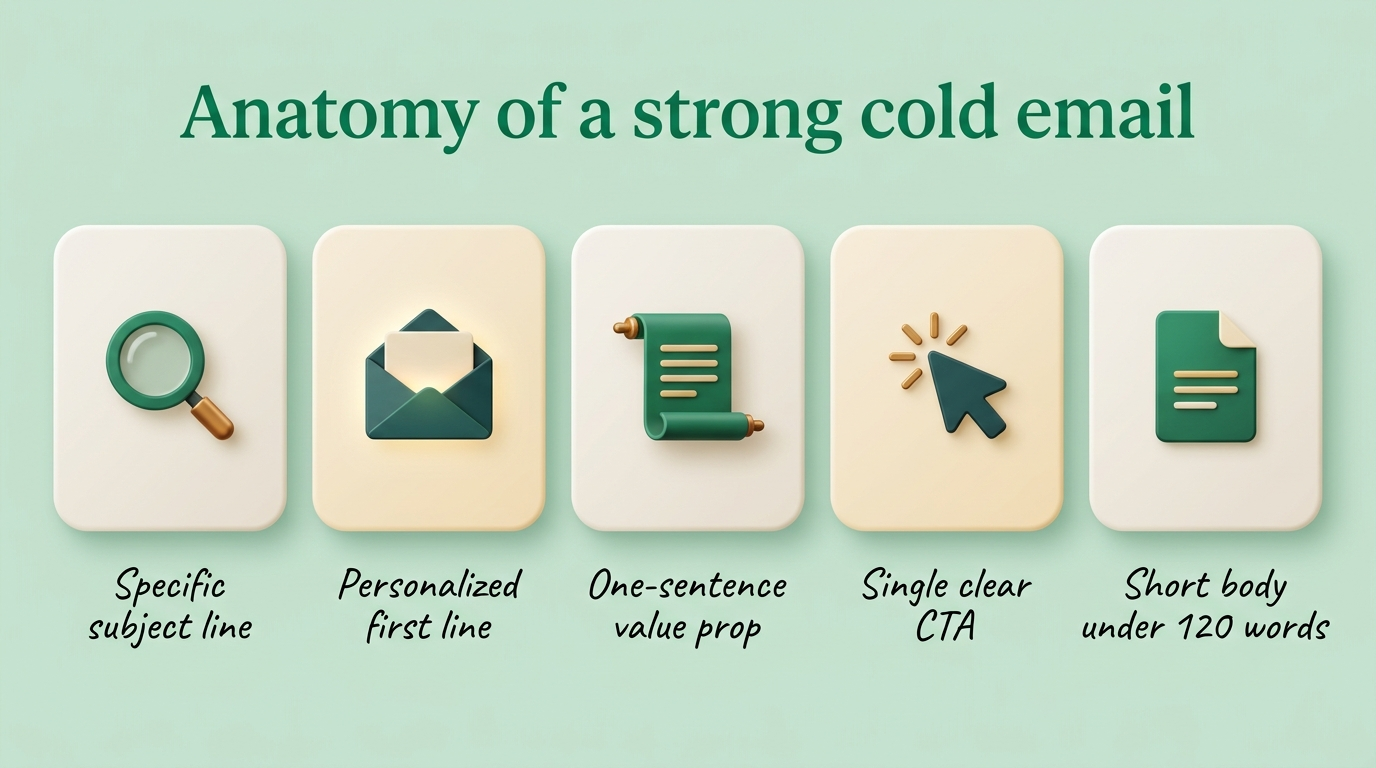
A specific subject line. Generic subject lines («Quick question,» «Following up») blend into a crowded inbox; specific ones referencing the company or a shared detail earn the open.
A personalized first line tied to the prospect. This is the line that proves the email wasn’t blasted to a thousand people at once — it references something true and current about the recipient.
A one-sentence relevant value proposition. State the outcome you offer in a single sentence, not a paragraph of features.
A single, clear call to action. One ask — a 15-minute call, a reply, a link — not three competing options that force the reader to choose.
A short, scannable body. Keep the whole message under roughly 120 words; cold outreach is read on a phone, standing up, between other tasks.
Why personalization is the engine
Personalization is the strongest lever on reply rate of any factor in the anatomy above. AI first-line tools scrape public data — the prospect’s name, company, title, website, and LinkedIn profile — to write a custom opener that reads as researched rather than templated. The risk runs the other way too: over-personalized lines that reference obscure, hyper-specific details can read as «creepy» rather than attentive, so the goal is relevant, not surveillance-y.
How to Write a Cold Email With AI, Step by Step
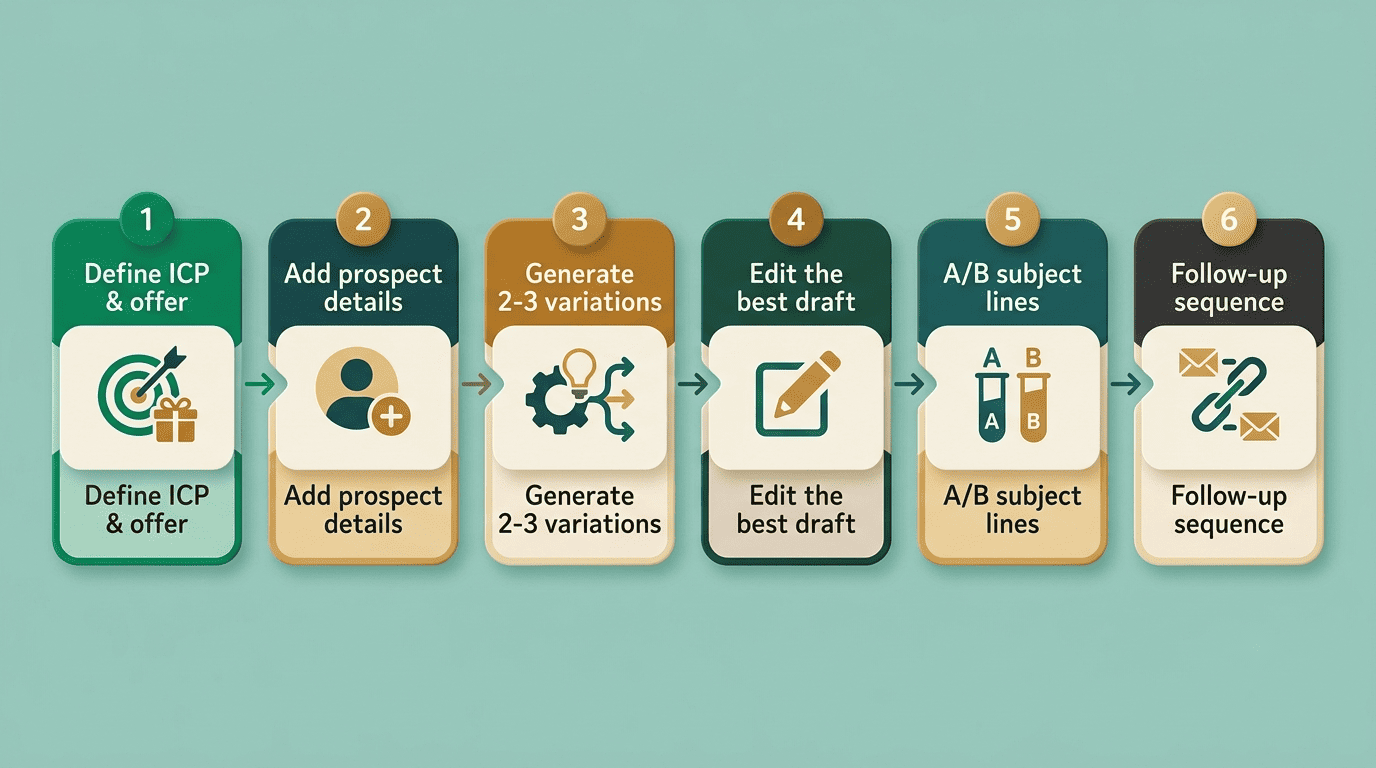
Here is a repeatable workflow for turning an AI email writer into a working part of an outreach process, from defining who you’re targeting to sending a sequence that gets answered.
- Define your ideal customer profile (ICP) and the one offer. Tell the AI email writer who you’re targeting and the single outcome you offer — vague inputs produce generic copy, and testers of these tools consistently find that input quality «makes or breaks» the output.
- Feed in the prospect’s details. Name, company, title, and any public context (a recent post, a product launch, a shared connection) give the AI something concrete to personalize around.
- Generate 2-3 variations. Don’t accept the first draft; ask for alternatives in a different tone or angle and compare them side by side.
- Edit the strongest draft. Cut fluff, tighten the CTA to one ask, and read it aloud to confirm it sounds like a person wrote it, not a template.
- Write subject-line variants. Generate 3-5 subject lines to A/B test rather than committing to one guess.
- Build a 2-3 step follow-up sequence. Space follow-ups a few days apart, and make each one add a new angle instead of repeating «just checking in.»
- Use merge tags for scale. Once the template earns replies, merge tags for name, company, and role let you personalize at scale without rewriting from zero each time.
More prompt detail consistently produces better output — the difference between «write a cold email to a SaaS founder» and a prompt that includes the founder’s actual product, recent funding round, and a specific pain point is the difference between copy that gets deleted and copy that gets a reply.
Subject Lines, Follow-Ups, and A/B Testing
Let AI generate variations, you pick the winner
AI email writers excel at volume: subject-line variations for A/B testing, follow-up sequences, and rewrites of copy that feels flat. Always A/B test AI-written copy against your own manually written versions — the VWO data above shows neither format wins by default, so the only way to know which performs better for your list is to run both.
Follow-ups do the heavy lifting
Most replies come from follow-ups, not the first email. A short 2-3 step sequence, spaced a few days apart, with each message adding a new angle rather than restating the first pitch, consistently outperforms a single one-and-done send.
| Sequence step | Timing | Goal |
|---|---|---|
| Email 1 | Day 0 | Introduce the offer, personalized opener |
| Follow-up 1 | Day 3-4 | New angle — a stat, a case study, or a different benefit |
| Follow-up 2 | Day 7-8 | Short, low-pressure nudge or a direct «not a fit?» close |
Deliverability, Spam Filters, and CAN-SPAM Compliance
Get into the inbox
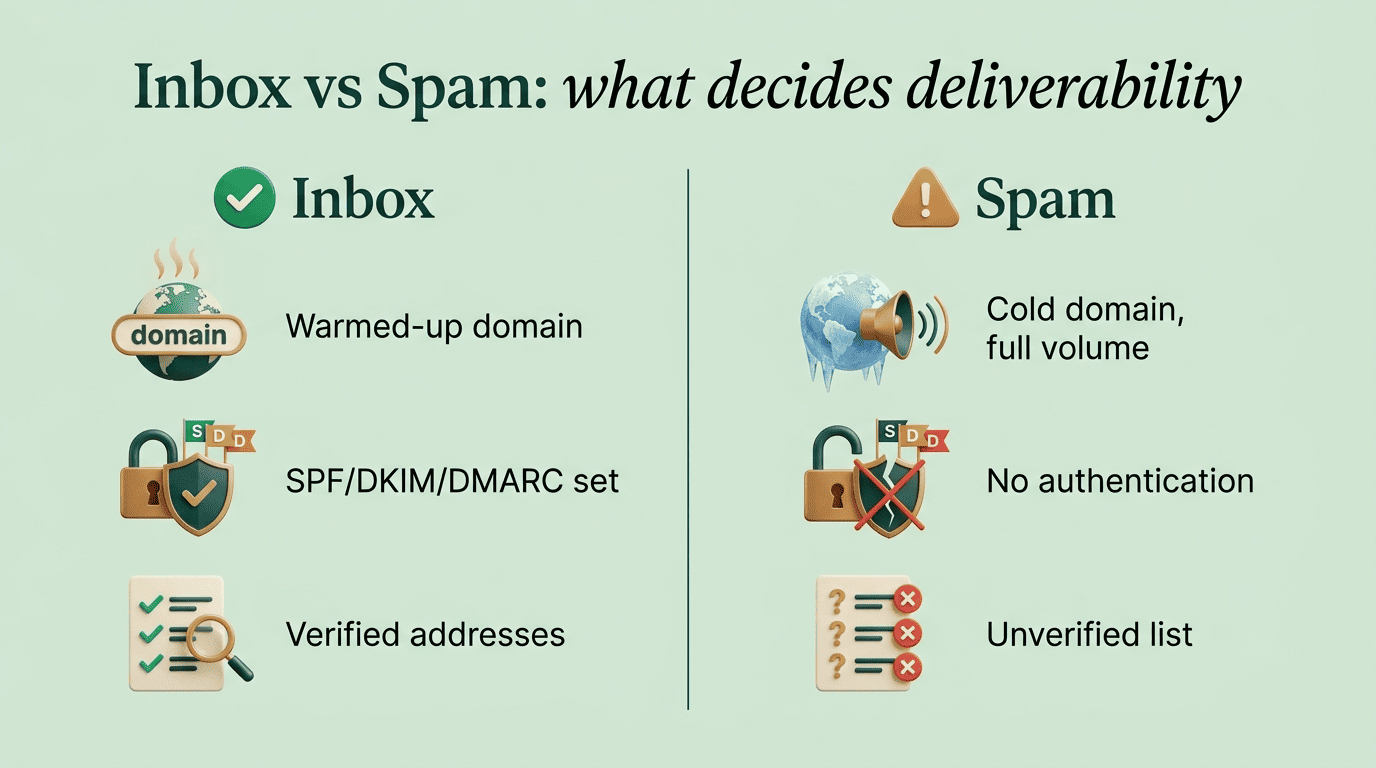
The best-written cold email fails if it never arrives. Deliverability depends on sender reputation, not just copy — a well-written email from a domain with a poor sending history still lands in spam. Google’s own email sender guidelines lay out the authentication and volume practices Gmail expects from senders, and following them materially improves inbox placement. Before scaling a cold outreach campaign, check off:
- Sending domain warmed up gradually over several weeks, not used at full volume from day one
- SPF, DKIM, and DMARC authentication configured for the sending domain
- Prospect addresses verified before send to keep bounce rates low
- Sending inboxes rotated across a sequence instead of hammering one address
- Send volume increased gradually as replies and opens confirm a healthy sender reputation
Stay legal
Commercial cold email sent in the US must comply with the CAN-SPAM Act, enforced by the Federal Trade Commission. That means an accurate «From» line and subject, a physical postal address in the message, and a working opt-out mechanism that’s honored promptly. An AI email writer generates the copy, but the sender — not the tool — is legally responsible for compliance.
The law’s scope is broader than most senders assume — it isn’t limited to mass blasts.
Despite its name, the CAN-SPAM Act doesn’t apply just to bulk email. It covers all commercial messages, which the law defines as «any electronic mail message the primary purpose of which is the commercial advertisement or promotion of a commercial product or service.»
Federal Trade Commission, CAN-SPAM Act Compliance Guide
That means a single one-to-one cold email sent by an AI email writer is covered by the same rules as a bulk marketing send — the sender responsibilities below apply regardless of volume. Treat the checklist as a floor, not a suggestion: violations carry real financial penalties, and «the AI wrote it» is not a defense.
The table below breaks the requirements down into what to actually check before you hit send.
| Requirement | What it means |
|---|---|
| Accurate header/subject | «From» and subject must reflect the real sender and content |
| Physical address | A valid postal address must appear in the email |
| Working opt-out | Recipients must be able to unsubscribe, honored within 10 business days |
| No deceptive claims | The offer and content must not misrepresent what’s being sold |
Best Practices and Mistakes to Avoid With an AI Email Writer
By 2026, AI email writing is a baseline capability, not a differentiator — inboxes are already full of «polished but generic» AI text that buyers now recognize on sight. What still separates a reply from a delete is what you do with the draft after the AI email writer hands it to you.

Do
- Edit every draft — no AI cold email generator output should go out unedited
- Personalize with real, current details, not just a name merge tag
- Keep the message short with a single, clear CTA
- A/B test subject lines, opening lines, and CTAs on an ongoing basis
- Favor in-platform AI, where writer, sending, and analytics live together, so copy and deliverability get tuned against the same reply data
Don’t
- Don’t mass-send unedited AI copy — it reads as generic and hurts reply rate
- Don’t skip personalization to save time; it’s the single strongest lever on replies
- Don’t stack more than one CTA into the same email
- Don’t treat AI writing as a differentiator — your targeting and editing are what still separate you from every other sender using the same tool
FAQ
Related guides: sales emails and follow-up emails.