
AI Email Writer for Payment Reminders and Overdue Invoices
Chasing an overdue invoice is one of the most uncomfortable emails to write — firm enough to get paid, polite enough to keep the client. An AI email writer drafts the whole reminder sequence, from a gentle nudge to a final notice, in seconds.

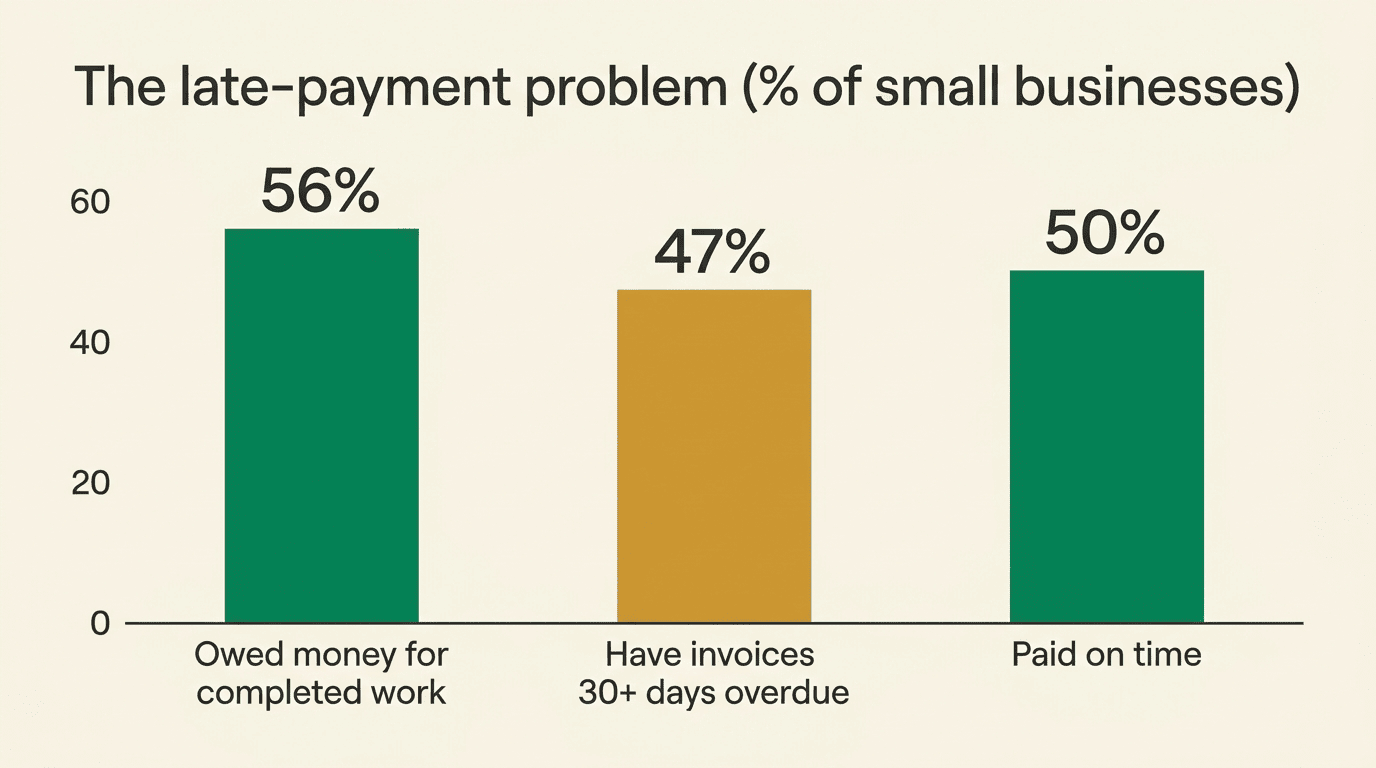
In one widely cited survey of small-business owners, 56% said they were currently owed money for completed work, and the average small business carries more than $17,000 in unpaid invoices at any given time. A structured reminder sequence, not a single awkward email, is what actually closes that gap.
Why Overdue Invoices Deserve a Real Reminder System
Unpaid invoices aren’t just an inbox annoyance — they’re a direct hit to how much cash a business has on hand to cover payroll, rent, and suppliers. The longer an invoice sits open, the more it behaves like an involuntary loan to the client.
Late payments are a cash-flow problem, not just an annoyance
Nearly half of businesses with open invoices say some of them are already more than 30 days past due, and industry payment-practices surveys put on-time payment rates for small businesses at only around half of invoices — meaning close to half routinely slip past their agreed terms. Tracking how long invoices sit unpaid — often measured as Days Sales Outstanding, or DSO — is one of the clearest early-warning signs of a cash-flow squeeze, and the U.S. Small Business Administration treats managing accounts receivable as a core financial-management task, not an afterthought.
Consistent follow-up is what actually gets you paid
Businesses that follow up on nearly every open invoice tend to collect payment within about a week of the due date, while those that only chase the largest balances leave much more sitting unpaid. The problem is rarely knowing that you should follow up — it’s finding time to write a new email for every client, every stage, which is exactly what an AI email assistant removes from the process.
When to Send Each Reminder: The Cadence
A reminder sequence works best when it’s predictable rather than reactive — sent on a schedule instead of whenever you happen to notice the balance is still open.
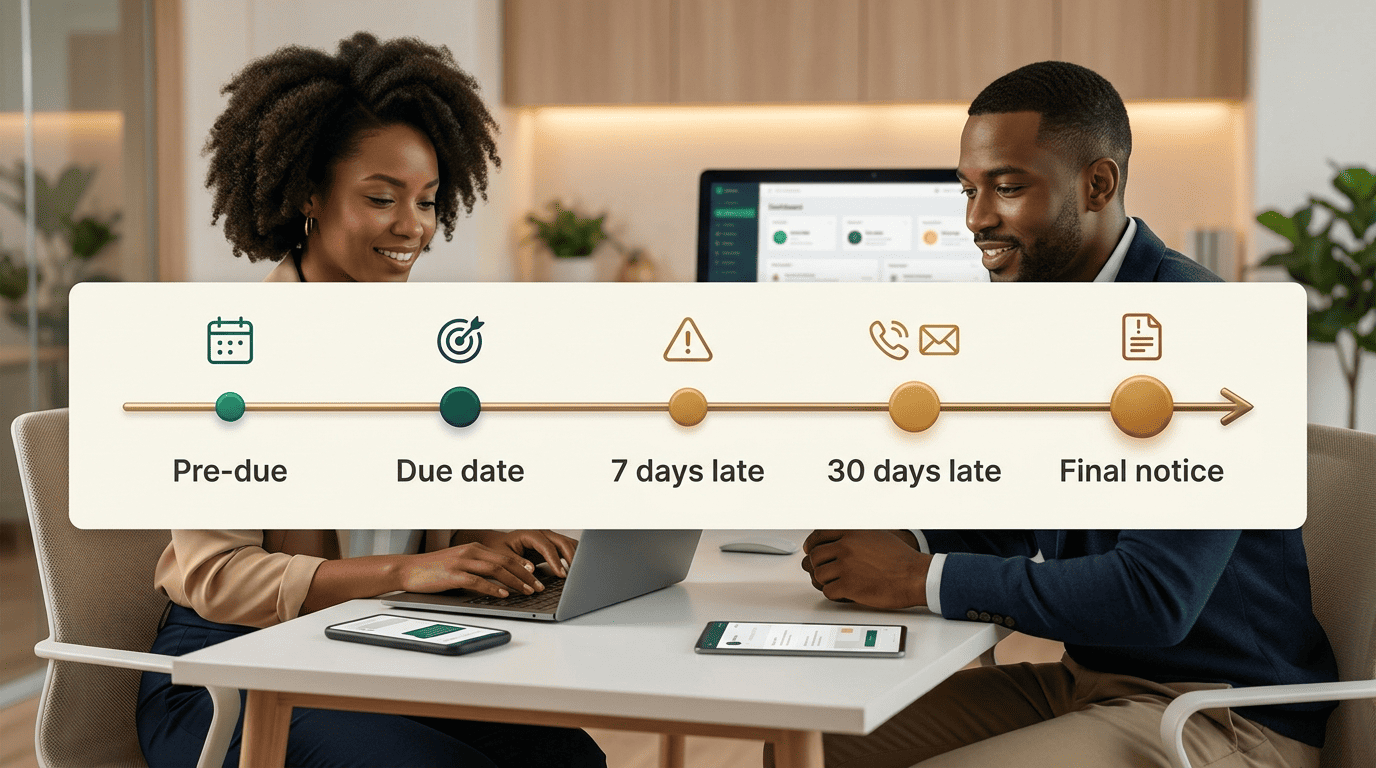
| Stage | Timing | Tone |
|---|---|---|
| Pre-due notice | 3-7 days before due date | Friendly courtesy heads-up |
| Due-date reminder | On the due date | Neutral, informational |
| First follow-up | 3 days overdue | Friendly, assumes oversight |
| Second follow-up | 7 days overdue | Firm, specific |
| Third follow-up | 14 days overdue | Firm, references late fee |
| Fourth follow-up | 30 days overdue | Serious, outlines next steps |
| Final notice | ~6 weeks overdue | Formal, final warning |
Following up within 7 days of the due date is associated with getting paid roughly twice as fast as waiting longer, and Tuesday through Thursday, mid-morning — roughly 9 to 11 a.m. — tends to perform best for B2B email in general. A professional AI email writer can draft this entire seven-stage sequence in one pass, so every step is ready to send the moment its trigger date arrives.
What Every Payment Reminder Email Should Include
A payment reminder only works if the recipient can act on it without emailing back to ask a clarifying question first.
The non-negotiable elements
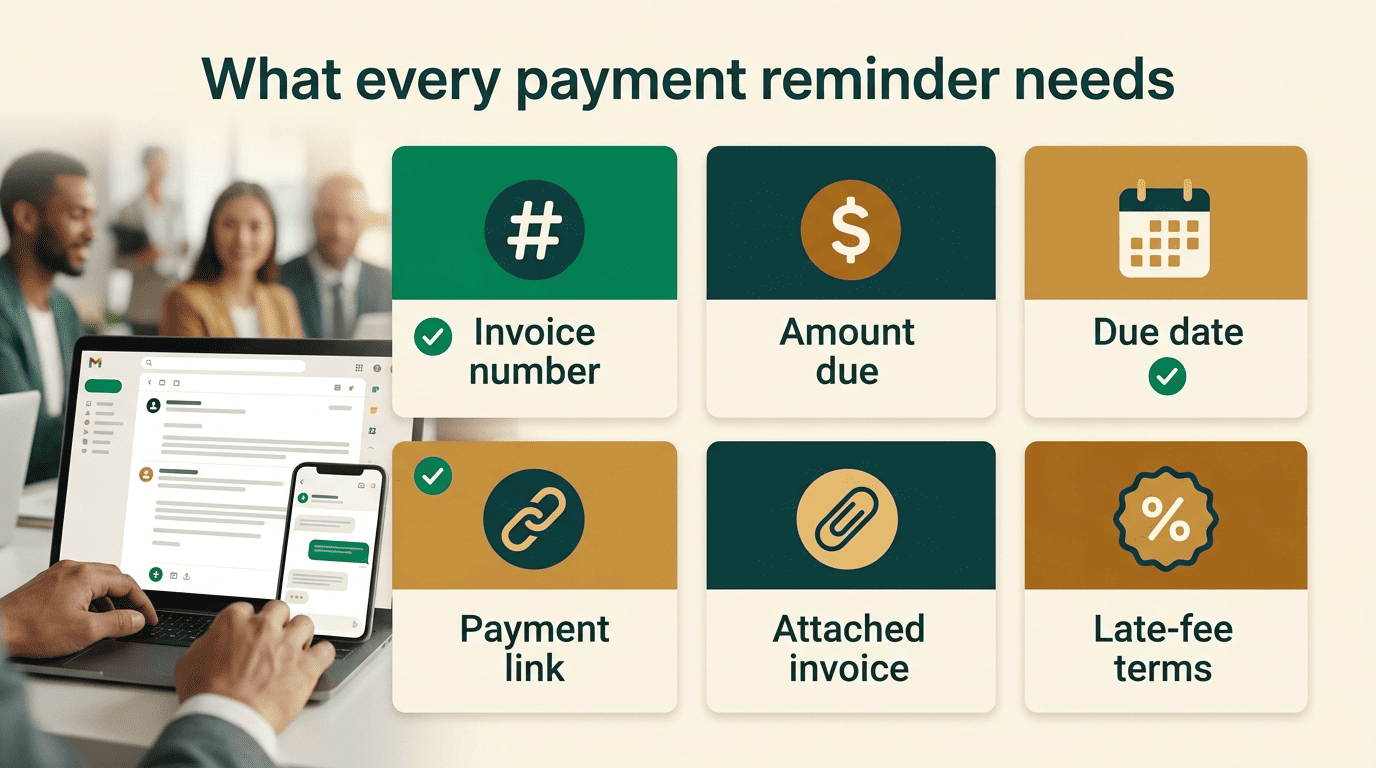
Every reminder should contain:
- The invoice number
- The exact amount due
- The original due date
- A clear payment link or accepted payment method
- The invoice itself, attached or linked
- Your direct contact information
- Any late-fee terms that apply
Keeping the body between roughly 50 and 125 words is associated with meaningfully higher reply rates than longer, over-explained emails — recipients skim, so the ask needs to be visible in the first two lines.
Subject lines that get opened
Keep the subject line under about 60 characters, and put the invoice number and due date directly in it so the email is unmistakable in a crowded inbox — something like «Invoice #4021 — Payment Due July 14.» An AI email writer can generate several subject-line variants tuned to each stage of the sequence, from a soft «Just a reminder» to a direct «Invoice #4021 is now overdue.»
Tone Escalation: Friendly, Firm, Final Notice
The hardest part of writing a reminder sequence by hand isn’t any single email — it’s making each one sound distinctly more serious than the last without ever sounding rude.
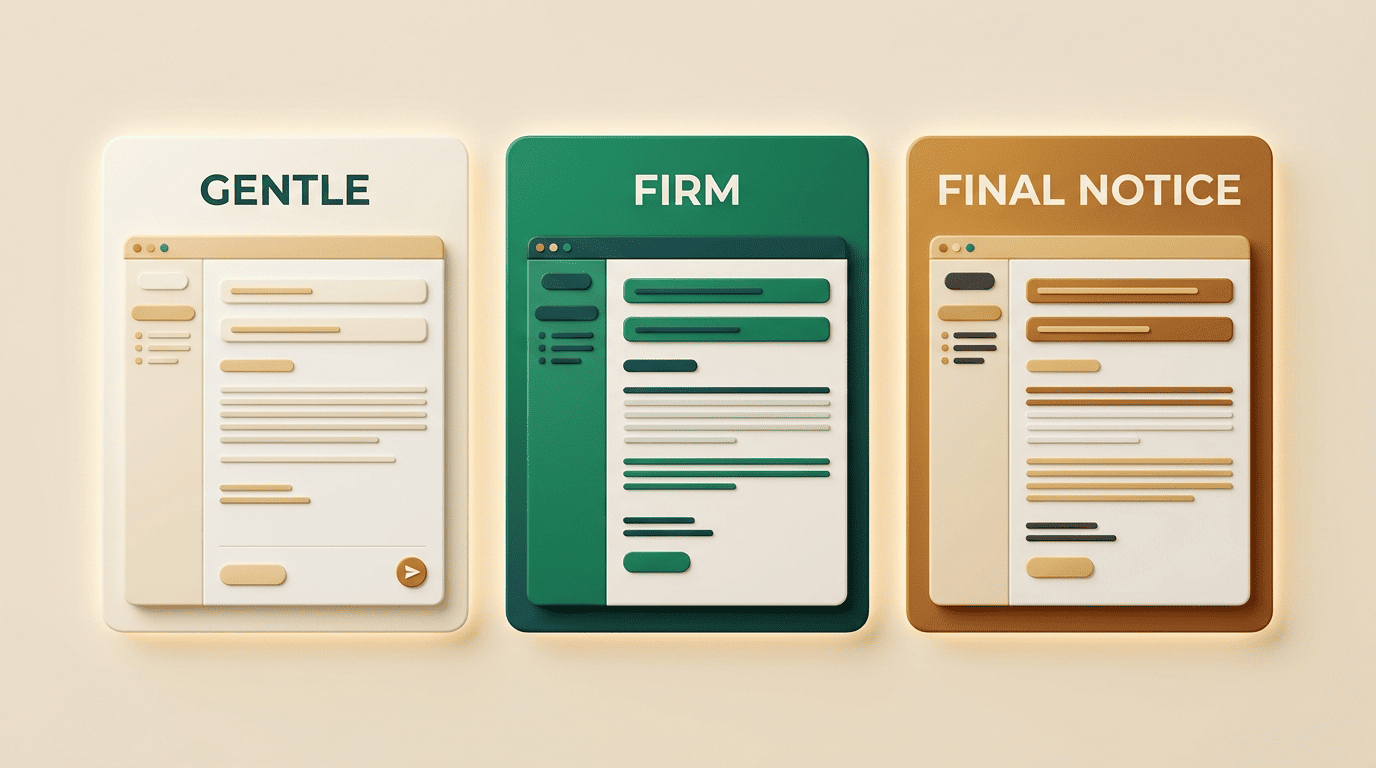
| Stage | Assumption | Language example |
|---|---|---|
| Gentle | Client simply forgot | «Just a friendly reminder that invoice #4021 is due soon.» |
| Firm | Client needs a clear nudge | «Invoice #4021 is now 14 days overdue. Payment is due upon receipt of this email.» |
| Final notice | Situation must be resolved | «This is a final notice for invoice #4021. Please remit payment within 5 business days to avoid further action.» |
Small wording swaps matter more than tone alone: replacing «You need to pay» with «Payment is now due» keeps the message assertive without sounding like an accusation. An AI email writer applies that same shift automatically as it moves from the gentle draft to the firm one to the final notice.
How an AI Email Writer Drafts the Whole Sequence
Instead of staring at a blank draft for each overdue account, you give the tool the client’s name, the invoice number, the amount, and how overdue it is — and it returns the gentle, firm, and final-notice versions together, already personalized.
It fills in the details automatically. Most tools use personalization variables like {{firstName}}, {{invoiceNumber}}, {{amount}}, and {{dueDate}} so the same template can be reused across every client without manual find-and-replace.
It varies the wording between clients. Sending five clients the exact same sentence structure reads as an obvious form letter; an AI email writer generates fresh phrasing for each recipient so reminders feel individually written even when they’re built from the same escalation logic.
It keeps the escalation consistent. Because the tool tracks which stage each invoice is at, the tone shift from gentle to firm to final happens in the right order automatically, instead of depending on someone remembering how many reminders have already gone out.
Late Fees and Staying Compliant
Adding urgency to a reminder is fine; adding a threat you have no intention of following through on is not — and for some businesses, it can cross into legal risk.
Charge fees you disclosed, and keep the language clean
A late fee should only appear in a reminder if it was already stated in the original payment terms — commonly in the range of 1% to 1.5% per month — since introducing one after the fact tends to trigger disputes rather than payment. Collection-related communication is also shaped by consumer-protection rules such as the Fair Debt Collection Practices Act, enforced in part by the Federal Trade Commission, which restricts harassing or misleading tactics even outside formal debt collection.
A debt collector may not engage in any conduct the natural consequence of which is to harass, oppress, or abuse any person in connection with the collection of a debt.
Fair Debt Collection Practices Act, § 806, via the Federal Trade Commission
Rules on debt collection and late fees vary by state and by the nature of the business, so it’s worth confirming your specific terms and thresholds with a local advisor rather than treating any single template as universal legal guidance. An AI email writer can keep the wording firm and factual — stating what is owed and what happens next — without drifting into intimidation.
When a Client Still Won’t Pay
If the final notice goes out and the balance is still unpaid, the next steps move beyond email.
- Call the client directly to confirm they received the notice and understand the balance owed.
- Offer a short payment plan if the client is willing to pay but needs more time.
- Send a formal written demand letter that states the amount, the deadline, and the consequences of continued non-payment.
- If there’s still no response, consider handing the account to a collections agency.
- For balances that justify it, small claims court is typically the lowest-cost formal option — organizations like SCORE outline the practical steps small businesses can take before reaching that point.
An AI email assistant can draft the formal demand-letter email that precedes those offline steps, keeping the language firm, accurate, and consistent with everything sent earlier in the sequence.
FAQ
Related guides: follow-up emails and replying to emails.